Interview with Riham Jafari – ActionAid Palestine
Communications and Advocacy Coordinator at ActionAid Palestine
Two years have passed since the war in Palestine began, two years that have devastated a land and scarred generations with cruelty, injustice and violence. Numbers alone can no longer capture the weight of daily oppression, nor can they convey the strength and dignity of those who, against all odds, continue to endure.
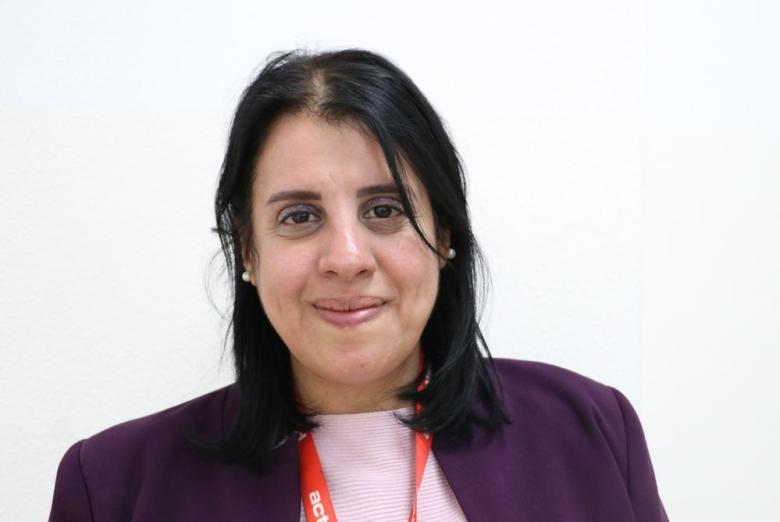
On 15 September we spoke with Riham Jafari, Communications and Advocacy Coordinator at ActionAid Palestine. Through her words, we aim to bring people back to the heart of the story, to see faces, to hear voices, and to remember that Palestinians are not asking for charity; they are asking for justice.
My message to your supporters is simple: stay with us. Your solidarity is not a slogan, a post or a protest, it is a lifeline. For every child in Gaza who looks up and sees drones instead of kites, for every mother piecing her home back together, for every father who carries his grief yet still chooses hope, your voices tell them: you’re not forgotten.
This struggle isn’t only about politics or borders. It’s about dignity, justice and the right to live free. Every time you speak out, march, write or even whisper a prayer, you break the silence that keeps oppression alive. You remind us that humanity hasn’t disappeared.
Don’t underestimate your voice. Change has always begun with those who refuse to look away, with people who hold on to truth when lies are loudest. Be steady. Be strong. Be kind. Every act of solidarity, no matter how small, builds a bridge of hope strong enough to outlast any wall or war.
Palestine isn’t asking for charity. Palestine is asking for justice. And together, our voices can be where freedom begins.
My childhood was like that of so many Palestinian refugees growing up in the camps of the West Bank. No playgrounds, only narrow alleyways and crumbling walls where we learned to run and to dream. Our laughter echoed through crowded homes made of tin and concrete, laughter shaped by loss and by stories of exile passed down through generations. We grew up too fast, learning the language of checkpoints, curfews and survival before we ever learned how to play. And yet there was always a spark, a quiet belief that we were meant for more than a life defined by fences.
For the children of Gaza, whose skies have been torn apart by years of war, I still dream of something different. If the world finds the courage to act, to break its silence, to end the war and their suffering, their future can still change. A future where classrooms are filled with light, not dust and debris, where the only sound in school is the bell, not the bombs, where open fields invite them to run without fear, and where their identity is no longer ‘displaced’ but ‘free’, built on dignity, peace and endless possibility.
Children should be learning to write their names, draw flowers and chase kites. But the children of Gaza learn the sounds of war, the buzz of drones, the whistle of missiles, the silence before an explosion, the weight of fear pressing on their chests at night. They didn’t choose this life. They didn’t choose to lose their homes, their schools, their parents. They just want what every child deserves: to wake up safe, to play freely, to dream without fear.
To the world I say: please, don’t look away. Your silence hurts as much as the bombs. We are not numbers. We are children, just like yours. And with every day this war continues, our future slips further away. Act now. Raise your voice. End the war. Stand with us. We’re still here, holding on to hope, waiting for the world to remember that our lives matter too.
Every day in Gaza is filled with pain: the bombings, the killings, the displacement, the hunger, the children who have lost limbs, the friends we have lost. But what has hurt me most is the hunger. Hunger is not just a lack of food; it is a slow, deliberate attack on life itself. I cried when I heard that my colleagues and their families had nothing to eat but a single piece of bread shared between them. Some of the women I work with, mothers, told me they go to bed hungry so their children can eat, and the children cry through the night, not because they fear the bombs, but because hunger gnaws at their small bodies.
Markets are empty and aid is being turned away. Even the simplest food has become a distant dream. Hunger takes more than strength; it takes dignity, leaving people to struggle for survival in silence while the world watches. To speak about hunger in Gaza is to speak of a cruelty created by human hands, a wound that deepens each day yet is still met with resilience, as people cling to the hope that the world will act before an entire generation disappears.
Working and communicating inside Gaza is incredibly hard. Humanitarian workers are often the only lifeline, trying to keep hope alive amid the chaos of the blockade and constant air strikes. With power cuts and broken connections, we depend on faint phone signals, handwritten notes and word of mouth to work out where food, water and medicine are needed most.
Getting aid through is never easy. The blockade on Gaza means humanitarian workers cannot enter, so we have to rely on local suppliers. It is incredibly difficult because trucks are turned back at the borders, supplies are running out and every delivery carries the risk of being hit in an air strike.
Still, our colleagues and partners act with urgency and courage. They mobilise community volunteers, set up distribution points and make sure the most vulnerable, older people, women, children and the sick, are reached first. Living under blockade means finding solutions that should never be needed, turning scarcity into resilience and holding on to the unshakeable belief that even a single food parcel or bottle of clean water can mean survival, dignity and proof that humanity has not abandoned Gaza.